

Last year, the production manager at a large kitchenware manufacturing plant in Gujarat stood beside stacked rejected stainless steel pots and sinks, facing an ultimatum from long-term European importers: fix inconsistent surface finishing within 60 days, or terminate all annual procurement contracts permanently.
Headquartered in Gujarat, India, this local large-scale manufacturer specializes in food-grade stainless steel cookware, kitchen sinks and hollowware, with 80% finished products exported to EU, Middle East and Southeast Asia markets. For two consecutive years, its locally purchased industrial sanding machine failed to meet unified export standards. The workshop suffered frequent finishing failures, repeated rework and delayed shipments. The factory tried three local industrial sanding machine manufacturer for equipment overhaul and upgrade, yet no supplier fixed the root technical defects. After global vendor screening, the factory partnered with us for a tailor-madestainless steel surface finishing solution to save its core export business.
Client Profile & Three Critical Production Pain Points
Client Overview
Unresolved Finishing Pain Points From Old Local Grinding Line
Uneven brushed texture: Manual pressure adjustment caused fluctuating sanding depth. Cookware surface showed chaotic dark-and-light lines, unable to pass EU visual inspection. Local machines had no adaptive compensation for abrasive wear.
Severe batch color deviation: Uncontrolled grinding heat led to inconsistent surface gloss, batch chromatic aberration ΔE higher than 1.8. Batch mixing was forbidden by European buyers.
Thin sheet thermal deformation: 0.6mm-1.2mm thin stainless steel substrate bent and warped during dry grinding. The product scrap rate stayed at 7%, causing massive material loss and order delay.
How We Delivered a High Quality Stainless Steel Polishing Machine Solution in India
Core Custom Equipment Configuration & Problem-Solving Logic
Online closed-loop roughness detection system [link to inspection polishing machine page] Real-time feeds surface Ra data back to the control system, automatically adjusting grinding speed to unify line depth and gloss. Eliminates texture chaos and batch color difference, supporting standardized food-grade stainless steel surface finishing.
Intelligent constant-pressure grinding heads [link to intelligent polisher product page] Patented servo constant pressure replaces manual pressure tuning. Avoids over-grinding on cookware curved surfaces, the core component of our high quality stainless steel polishing machine.
Abrasive belt wear automatic compensation system [link to sanding auxiliary system page] Automatically corrects sand belt deviation, tension attenuation and elongation during long-shift operation. Keeps consistent grinding track, reduces manual belt replacement frequency.
Thin plate dynamic clamping & cooling moduleAll-around circulating cooling dissipates grinding friction heat instantly. Solves thin-board warping fundamentally, lowers heat-caused scrap rate for ultra-thin stainless steel cookware.
Multi-zone independent pressure control systemSeparates pressure parameters for flat surface, curved edge and bottom corner of pots, realizing one-piece uniform finish from edge to center. Compatible from satin brushing to high-standard mirror finish polishing machine processing demands.
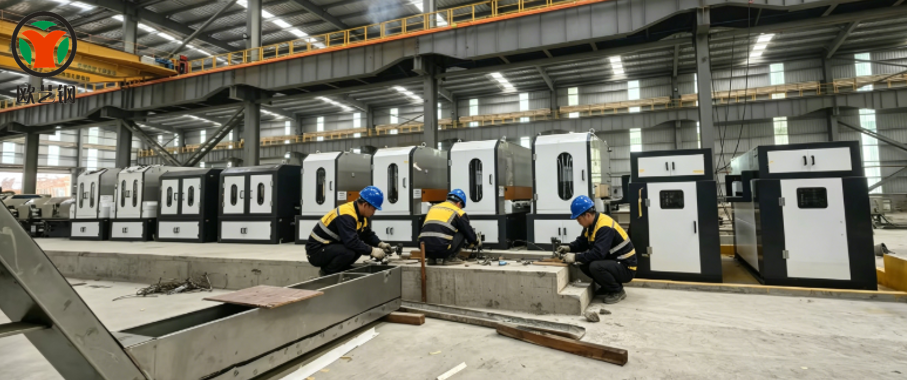
Full-Cycle On-Site Installation and Training On-Site in Gujarat Factory
Quantifiable Operational Results After Line Launch
Surface texture unevenness reduced by 82%
Batch chromatic aberration ΔE strictly controlled within 0.4, fully compliant with EU export inspection
Thin plate thermal deformation scrap rate dropped from 7% to 0.3%
Monthly cookware polishing production capacity increased by 45%
Abrasive sand belt service life extended by 58%, cutting monthly consumable procurement cost
Beyond Installation: Global Rapid After-Sales Support Verification
Client sent WhatsApp fault video and code at 19:00 local time;
Our global after-sales team finished remote diagnosis within 90 minutes, confirmed spare part model;
Arranged engineer with original spare parts to board flight within 24 hours;
Engineer arrived on-site within 48 hours, finished replacement and debugging, restored full production within 8 working hours.